
Millie
Millie is a chestnut Quarter Pony mare that stands 14.1 hands. We will have more information about her, and a photo coming soon.
Millie is a chestnut Quarter Pony mare that stands 14.1 hands. We will have more information about her, and a photo coming soon.
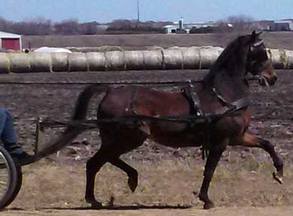

Marin is a beautiful bay medium-pony-size hackney pony mare who came to us from the “Fillmore 55” humane case. She was foaled in approximately 2001. Marin is broke to drive and has that great snappy hackney pony trot as you can see from her photo. Marin would not be suitable for children at this point as she has a lot of “go” and was not handled as much or as kindly as she should have been in the past.
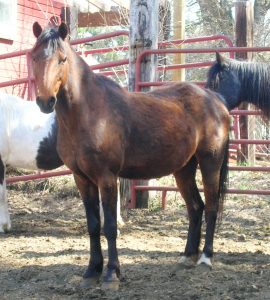
Many physiological functions in horses are influenced by body condition including the horse’s maintenance, reproductive and exercising requirements. A system called Body Condition Scoring can be used to rate ideal body condition. This condition scoring system is based on visual appearance and palpable fat cover on six areas of your horse’s body.

The ideal body condition scoring is between 5 and 7.
1 • Poor – Animal extremely emaciated; spinous processes, ribs, tailhead, tuber coxae (hip joints), and ischia (lower pelvic bones) projecting prominently; bone structure of withers, shoulders, and neck easily noticeable; no fatty tissue can be felt.
2 • Very Thin – Animal emaciated; slight fat covering over base of spinous processes, transverse processes of lumbar vertebrae feel rounded; spinous processes, ribs, tailhead, tuber coxae, and ischia prominent; withers, shoulders, and neck structure faintly discernable.
3 • Thin – Fat buildup about halfway on spinous processes; transverse processes cannot be felt; slight fat cover over ribs; spinous processes and ribs easily discernable; tailhead prominent, but individual vertebrae cannot be identified visually; tuber coxae, appear rounded but easily discernable; tuber ischia not distinguishable; withers, shoulders and neck accentuated.
4 • Moderately Thin – Slight ridge along back; faint outline of ribs discernable; tailhead prominence depends on conformation, fat can be felt around it; tuber coxae not discernable; withers, shoulders and neck not obviously thin.
5 • Moderate – Back is flat (no crease or ridge); ribs not visually distinguishable but easily felt; fat around tailhead beginning to feel spongy; withers appear rounded over spinous process; shoulders and neck blend smoothing into body.
6 • Moderate Fleshy – May have slight crease down back; fat over ribs spongy; fat around tailhead soft; fat beginning to be deposited along the side of the withers, behind shoulders, and along side of neck.
7 • Fleshy – May have slight crease down back; individual ribs can be felt, but noticeable filling between ribs with fat; fat around tailhead soft; fat deposited along withers, behind shoulders, and along neck.
8 • Fat – Crease down back; difficult to feel ribs, fat around tailhead very soft; fat area along withers filled with fat, area behind shoulder filled with fat, noticeable thickening of neck; fat deposited along inner thighs.
9 • Extremely Fat – Obvious crease down back; patchy fat appearing over ribs, bulging fat around tailhead; along withers, behind shoulders and along neck, fat along inner thighs may rub together; flank filled with fat.
ANTHRAX
Anthrax is a bacterial disease caused by the organism Bacillus anthracis. Horses most commonly show septicemia with enteritis and colic. The disease is known worldwide, but is not common in the United States. Most cases are reported curing the warm summer months. Vaccination is only recommended in enzootic areas of the country (i.e. South Dakota, Louisiana, Texas, Missouri, California, and Arkansas). In the case of an outbreak, only those animals not exhibiting clinical signs should be vaccinated.
BOTULISM
Botulism is a neuroparalytic disease caused by the organism Clostridium botulism. In North America, type B is most commonly found in the Mid-Atlantic States and Kentucky, type A is prevalent west of the Rocky Mountains, and type C is typical in Florida. Most foals are infected by growth of the bacterium within the gastrointestinal tract between 2 weeks and 8 months of age and are referred to as having “shaker foal syndrome”. Adult horses are most commonly infected via ingestion of preformed toxins referred to as “forage poisoning”. Clinical symptoms include progressive muscle paralysis affecting the limbs, jaw, and throat muscles. Frequent paralysis of the upper eyelid, tongue, and tail are also noted.
ENCEPHALOMYELITIS
Encephalomyelitis is a viral disease also known as “sleeping sickness”. The three types are Eastern, Western and Venezuelan. The disease is characterized by various neurological signs, including excitement, dementia, head pressing, and circling. Transmission occurs by mosquitoes, and the disease is associated with areas inhabited by them and where winter temperatures are not severe. Vaccination before mosquito season and biannually in humid areas of the country is recommended. Initial dose should be boostered in 3-4 weeks. Horses should be re-vaccinated 2-3 times yearly thereafter.
EQUINE VIRAL ARTERITIS
Equine viral arteritis is a viral disease that can cause respiratory disease and abortion in horses. The vaccine is only recommended for use in stallions, open mares, and young horses 6 weeks of age or older. Pregnant mares and open mares or stallions that are within 3 weeks of being bred should not be vaccinated.
INFLUENZA
Influenza is an acute viral disease that affects the upper respiratory tract of horses. The disease spreads rapidly and outbreaks can occur any time of the year – commonly among young horses moved into larger populations at training barns, racetracks, and show grounds. Symptoms include a dry cough, fever, nasal discharge, loss of appetite, and muscle soreness. Coughing is the most common sign, often lasting 1-3 weeks. Vaccination is by a killed-virus vaccine, which requires frequent administration every 2-6 months to provide appropriate protection to susceptible horses. The vaccine is available in monovalent or polyvalent forms. A post vaccination fever is sometimes detected in some horses, while others may show a loss of appetite and depression. Once a horse is infected, the upper respiratory tract takes three weeks after remission of the disease to renew itself. It is important to vaccinate the competitive and/or show horse(s) traveling to and from show, sales and breeding farms. Current recommended vaccination schedules are very 6 months for adult horses at low to moderate risk and every 1-3 months for high-risk animals. Vaccinations should be administered 2-3 weeks before a stressful event because of the increase chance of the previously mentioned side effects.
POTOMAC HORSE FEVER
Potomac horse fever (equine monocytic ehrlichiosis) is an acute enteric disease characterized by diarrhea, depression, reduce gut motility, and often laminitis due to infection by Ehrlichia risticii. PHF is a seasonal disease, occurring mostly in late spring to early fall and has been reported mainly in the northeastern United States and Canada. As soon as PHF occurs on a farm, there is a high risk of recurrence. It is believed an insect vector is responsible for transmission of the disease. If an infected horse survives, it will develop immunity for about 2 years. Vaccines offer short-term protection and revaccination every 4-6 months is recommended.
RABIES
Rabies is a neurological rhabdovirus disease with clinical signs that range from lethargy to bizarre, frightening behavior. Symptoms may include colic, lameness, muscle in-coordination, incontinence, muscle spasms, paralysis, blindness, depression, and aggression. Horses in enzootic areas should be vaccinated; especially those exposed to wildlife. Rabies is invariably fatal in unvaccinated animals and is zoonotic; therefore, exposed horses should be euthanized or isolated and closely observed by a veterinarian for 6 months. Vaccination of unvaccinated horses after exposure to the disease is not recommended. Rabies vaccine should be administered in the lower thigh, not in the neck, due to a local tissue reaction.
RHINOPHEUMONITIS
Rhinopneumonitis is a viral disease caused by a herpesvirus. This highly infectious disease can cause respiratory infection, paralysis, and death in horses. EHV-1 causes abortions in pregnant mares, usually in the last three months of pregnancy. WHV-4 is prevalent among young horses. Symptoms include fever, depression, loss of appetite, swollen lymph nodes, and profuse nasal discharge. Rhino vaccines offer short-term immunity and require frequent administration. Vaccination every 2-3 months is recommended, depending on the environmental risk. Preventative medicine is best when combined product is used (EHV-1 & EHV-1b). Pregnant mares should be vaccinated at 5, 7, and 9 months of gestation with approved vaccines. Initial dose must be boostered in four to six weeks with annual revaccination required.
STRANGLES
Strangles (distemper, barn fever) is an infectious, highly contagious bacterial disease mostly seen in young horses and caused by Streptococcus equi. The bacteria invade the mucous membranes of the nose and throat causing severe inflammation and pain. The extreme swelling of the lymph nodes causes the horse to sound as if it is being strangled, thus the origin of the name “strangles”. Abscesses mainly occur in the throatlatch region or between the jaws and can cause immense distress to infected horses. Horses presently in, or going to be in, a high-risk environment should be vaccinated. Broodmares should be vaccinated 3 to 6 weeks prior to foaling and foals should be vaccinated at 2-3 months of age and again at 6 months of age. Adult horses that are not at a high risk are usually not vaccinated for this disease. Depending on the environment, either annual or biannual vaccinating can be practiced.
TETANUS
Tetanus is a non-infectious disease caused by a bacterium and is characterized by a general increase in muscle stiffness, tremors, lockjaw, and prolapsed third eyelid. Horses display a “sawhorse” stance when exhibiting clinical signs of the disease. Clostridium tetani, the causative organism, is found in the soil worldwide, and infection is associated with high mortality. Horses with no history of immunization that are injured or undergo surgery are at a high risk for tetanus. Animals should receive tetanus toxoid and tetanus antitoxin administered at two separate locations on the body. This gives the horse active (tetanus toxoid) and passive (tetanus antitoxin) immunity for protection. A booster should be given annually or at any time of exposure.
By Laurie Fio
In the summer of 1999, West Nile fever appeared in New York and caused great concern among health officials as it claimed the lives of birds, horses and humans. The University of California, Davis Center for Equine Health and the Bernard and Gloria Salick Equine Viral Disease Laboratory responded by hosting a meeting with regulatory officials in various state and government health agencies, viral disease experts and representatives of the equine industry. The seminar provided a forum to discuss the implications of West Nile fever on the California equine industry and to help prepare for another outbreak. As a follow-up to that seminar, this is an update on the current status of West Nile fever.
West Nile fever is a mosquito transmitted viral disease of humans and animals whose natural life cycle involves viral transmission between mosquitoes and birds. West Nile virus (WNV) occurs throughout much of Africa, the Middle East, Asia and Europe. WNV first appeared in the Western Hemisphere in 1999 in Queens, New York, where it caused disease in humans, birds and animals. Currently, crows and blue jays are especially susceptible hosts in the United States, but the 1999 U.S. outbreak also infected a substantial number of humans (7 deaths) and horses (9 deaths). In addition to causing death and neurologic disease in horses, WNV outbreak resulted in the European community imposing movement restrictions of horses from affected areas.
The 2000-year began with many questions as to how WNV infection would develop in the United States. Optimistically, some scientists predicted that the epidemic would burn itself out. However, others speculated that the virus would rapidly become endemic throughout the entire United States. As the year has progressed, it has become increasingly clear that the latter opinion is likely to be correct.
The isolation of WNV from both insects and birds during the winter of 2000 confirmed that it had indeed overwintered and with the advent of the vector season this past summer, the virus rapidly and dramatically expanded its incursional foothold. Despite widespread spraying of insecticide to kill the mosquito vectors, the virus now has been positively identified in 11 states as well as the District of Columbia.
Many varieties of mosquitoes have been identified as carriers of WNV, several of which are native to the United States. So far this year, WNV infection has been confirmed in nearly 4,000 birds (mainly crows), 18 humans (one fatality), and in other animals including the bat, rabbit, cat, raccoon, squirrel, skunk and chipmunk. In horses, 53 cases of WNV infection have now been confirmed in eight states including New York, Rhode Island, New Jersey, Maryland, Massachusetts, Connecticut, Pennsylvania and Delaware. At least 22 of these horses either died or were euthanized.
In horses, WNV infection can cause severe neurologic disease and associated encephalitis. Other diseases that can be easily confused with West Nile fever include rabies, eastern, western and Venezuelan equine encephalitis, and the California serogroup Bunyaviruses. All of these diseases cause viral encephalitis in horses. Horsemen should also be aware that the clinical manifestations of West Nile fever could be confused with the symptoms of equine protozoal myeloencephalitis (EPM).
Another issue that causes concern is the occurrence of subclinical WNV infection in horses (infection occurs but the horse shows no signs of disease). In test horses, which were experimentally infected with WNV, only a low incidence of disease occurred which, indicates that subclinical infections are common. If true, further study is also necessary to determine if there is a risk of spreading disease from these carrier horses. Vaccination is considered a viable option for the future; however, a vaccine suitable for use in horses still needs to be developed.
Perhaps, the most disturbing aspect of the 2000 WNV epidemic is the rapid southward extension of the virus, which strongly suggests that it could soon establish a year-round cycle of infection in warmer regions of the southeastern United States. Many experts now predict that WNV infection will spread to all 48 contiguous states of the Unites States, as well as extensive areas of the Caribbean, and Central and South America. As a consequence, movement restrictions might be imposed on horses from regions in which WNV infection becomes endemic.
An additional very disturbing aspect of WNV infection is that extremely high levels of the visor occur in the blood of susceptible birds such as crows and the virus can be directly transmitted between birds without a mosquito vector. This direct transmission of WNV certainly raises enormous public health issues, particularly for laboratory personnel handling suspect birds and mammals. Because of this threat, WNV is classified in the United States as a BL-e pathogen, a level that mandates sophisticated facilities and strict protocol for the safe handling of diagnostic specimens.
Despite the fact that events such as the Sydney Olympic Games and race meets on the eastern seaboard were not impacted this year, the adverse impact of WNV on the U.S. equine industry will undoubtedly increase. During an extensive outbreak of WNV infection of horses in southern Europe (40 horses died in France this summer), the European Union again imposed movement restrictions of horses from WNV-endemic areas in the United States. Because of the considerable mortality that has occurred in WNV-infected horses in both the United States and France, it is feared that the ultimate economic hardship imposed on the equine industry by WNV could be devastated if left unchecked.
In response to these uncertainties, scientists from the Bernard and Gloria Salick Equine Viral Disease Laboratory have initiated a collaborative research investigation on WNV infection of horses with scientists at the equine research Center, Faculty of Veterinary Science, University of Pretoria, South Africa. South Africa provides a unique environment in which to study the evolution and epidemiology of WNV in a region where WNV infection is endemic, yet disease rarely is reported in either humans or horses. The Maurice Stans Foundation, The Equine Research Center in South Africa, and the Bernard and Gloria Salick Equine Viral Disease Laboratory Endowment have generously supplied funding support for this research support for this research.
In summary, it appears that what scientists feared from last year’s WNV outbreak has occurred: WNV appears to be establishing itself in the United States and may become yet another infectious viral disease of humans and animals that is endemic to the United States. The Center for Equine Health and the Bernard and Gloria Salick Equine Viral Disease Laboratory are facing the challenge head on by establishing a network of scientific experts and conducting the necessary research to establish effective preventive measures and treatment protocols.
Published by:
The Center for Equine Health
UC Davis School of Veterinary Medicine,
One Shields Ave.,
Davis, CA 95616-8589
Phone: 530-752-6433
FAX: 530-752-9379
